
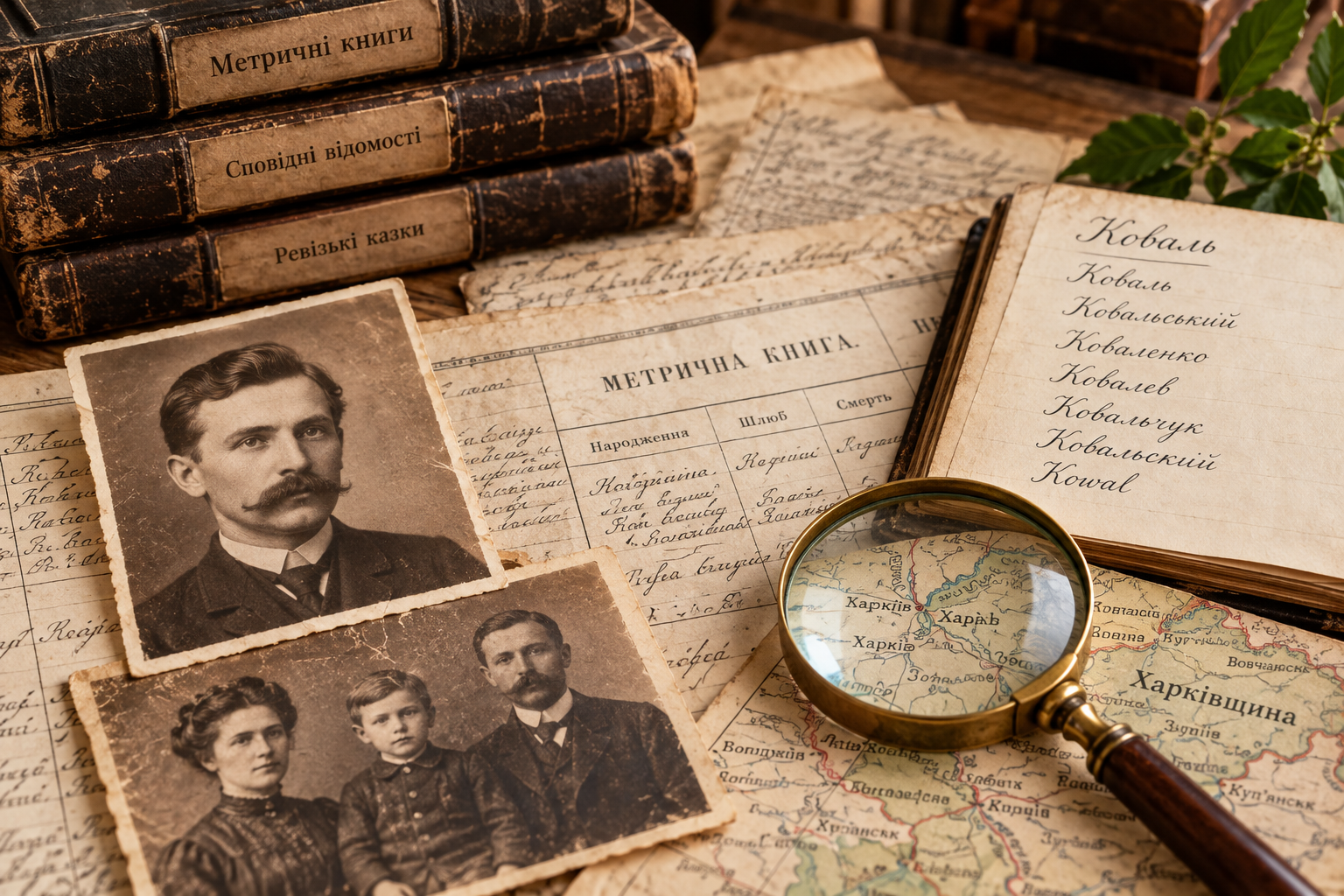
Sometimes, a family’s history begins with a single surname written on the back of an old photograph or a few memories of a great-grandfather. We may know the names of our grandparents but have very little information about earlier generations. Can you find your ancestors using only a surname? Where can you find records of people who lived in Ukraine 100–300 years ago? And how can you trace your family tree if your family documents have been lost?
Finding ancestors by surname in Ukraine is possible, but reliable results require comparing surnames, dates, locations, and historical records. Let’s explore how genealogical research works.
Can You Trace Your Ancestry Using Only a Surname?
A surname is a useful starting point, but it is not enough to establish family relationships. For example, the surname Koval is common in many regions of Ukraine. People sharing this surname are not necessarily related.
For more accurate research, it helps to know:
- Your ancestor’s first name, surname, and patronymic.
- Approximate dates of birth and death.
- The village or town where they lived.
- Names of parents, spouses, and children.
- Religious affiliation and occupation, if known.
The more information you have, the easier it becomes to identify the correct family among people with similar names.
Why Did Our Ancestors’ Surnames Change?
When working with historical archives, researchers often discover different spellings of the same surname. This happened because Ukrainian territories belonged to different states throughout history. Records were written in Ukrainian, Polish, Russian, Latin, German, and other languages. Surnames could change due to pronunciation, spelling conventions, clerical errors, or family circumstances. Professional genealogical research therefore involves checking several possible variations of a surname.
Important: Matching surnames do not prove a family relationship. Connections must be verified using additional historical sources.
What Documents Can Help You Find Your Ancestors?
Ukrainian archives contain various historical records that can help reconstruct a family tree.
| Document Type | Information You Can Find |
|---|---|
| Parish registers | Births, marriages, deaths, and parents’ names |
| Revision lists | Household members, ages, and family relationships |
| Confession lists | Household composition and family connections |
| Civil registration records | Births, marriages, and deaths in more recent periods |
| Family registers | Relatives and places of residence |
| Military records | Service, conscription, and biographical information |
| Land records | Land ownership and property information |
Parish Registers
Parish registers are among the most valuable sources of genealogical information. They contain records of births, baptisms, marriages, and deaths. Sometimes, a single entry can reveal information about several family members. For example, a great-grandfather’s marriage record may include his parents’ names and the family’s place of origin.
Revision Lists
Revision lists, also known as revizskie skazki, were compiled during tax censuses in the Russian Empire. They recorded household members, ages, and changes in family composition. In certain regions of Ukraine, these records can help trace family lines through the 18th and 19th centuries.
Confession Lists
These church records often listed families belonging to a particular parish. They can help researchers identify household members and distinguish between people with the same surname living in the same village.
Where Can You Search for Ancestors in Ukraine?
There is no single archive containing records of every Ukrainian family. Historical documents are distributed among different institutions, so genealogical research usually begins by identifying where your ancestors lived.
Regional State Archives
Regional archives may contain parish registers, administrative documents, family lists, and other historical materials. For example, if your ancestors lived in the Kharkiv region, your research might begin with the State Archives of Kharkiv Oblast. However, some records may be stored in other regions because administrative boundaries have changed over time.
Central Historical Archives
Two important institutions for genealogical research are:
- Central State Historical Archives of Ukraine in Kyiv.
- Central State Historical Archives of Ukraine in Lviv.
These archives preserve documents from different historical periods, including records from religious communities and government institutions.
Archives in Other Countries
Documents relating to ancestors from Galicia, Volhynia, Bukovina, and Zakarpattia may also be held in Poland, Austria, Romania, Hungary, and other countries. This is a result of historical border changes and shifting administrative jurisdictions.
Can You Find Your Ancestors Online?
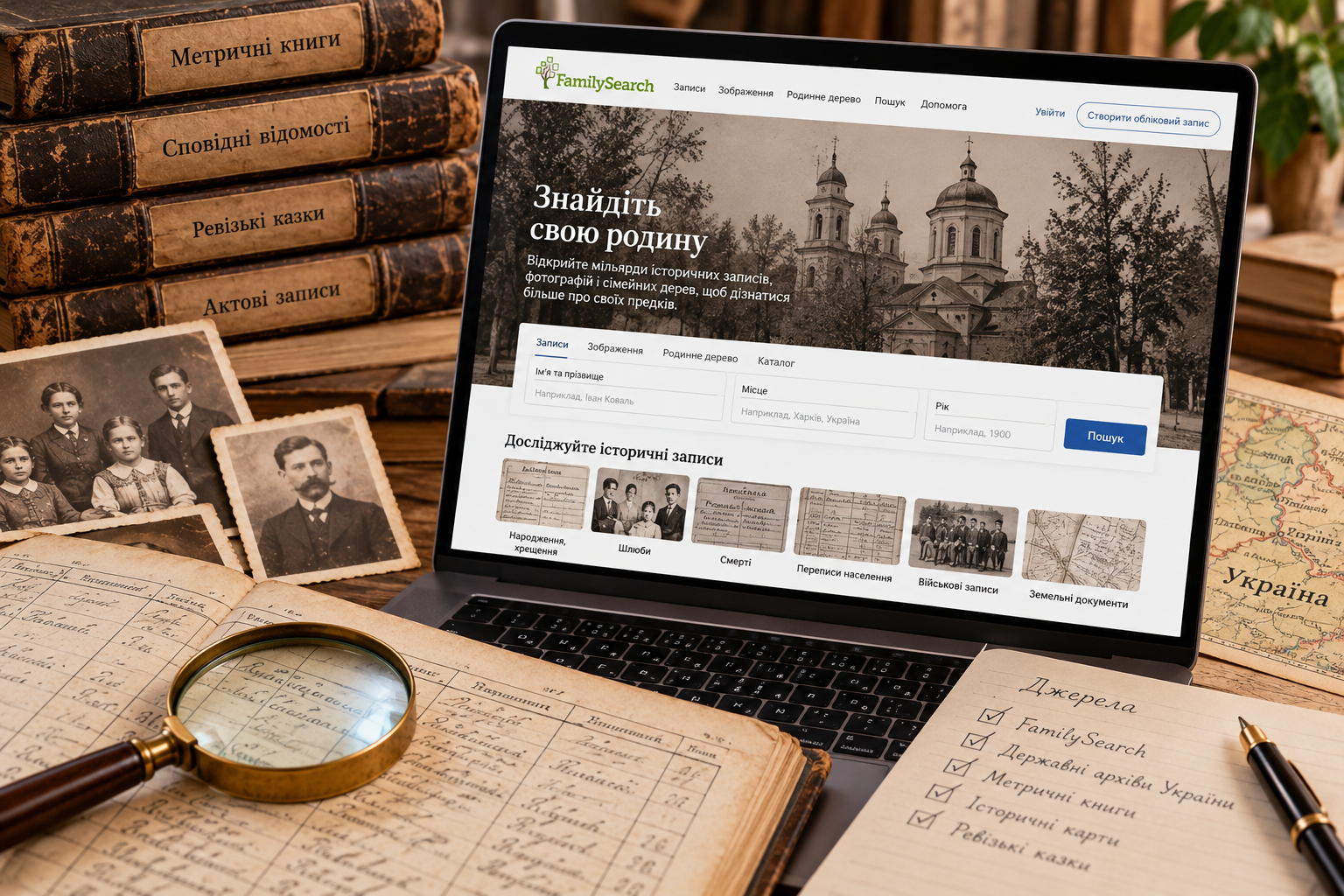
Yes. Some historical records have already been digitized and are available online.
Useful resources for independent research include:
- FamilySearch — an international genealogy platform offering access to historical records.
- Online catalogs of Ukrainian state archives.
- Digitized parish registers.
- Historical directories and maps of towns and villages.
However, not all documents are searchable by surname. Many sources are available only as scanned pages that must be examined manually. Additionally, a significant portion of archival materials has not yet been digitized.
How Can You Find Ancestors If You Only Know Their Village?
Knowing the name of a village can sometimes be more useful than knowing a surname. Imagine that you know your great-grandfather’s name and the village in the Kharkiv region where he lived in the early 20th century.
The research process might look like this:
- Identify the village’s historical name and administrative jurisdiction.
- Determine which parish served the family.
- Locate parish registers covering the approximate period of your great-grandfather’s birth.
- Identify his parents.
- Search for records of their marriage and births.
- Continue researching earlier generations.
By following these steps, it may be possible to reconstruct several generations of family history.
How Far Back Can You Trace Your Family Tree?
The depth of genealogical research depends largely on the survival of historical records. In some cases, families can be traced back to the 19th century. In others, research may reach the 18th or even the 17th century. Results depend on the region, the family’s social background, religious affiliation, and the availability of archival sources.
The most important factor is not the number of generations discovered, but having reliable documentary evidence for each family connection.
When essential records are missing, researchers may use alternative sources, including land documents, military lists, court files, and migration records.
Professional Genealogical Research vs. Independent Research
You can begin your family history research independently by collecting family photographs, interviewing relatives, and exploring online archives. However, more extensive research often requires knowledge of historical geography, archival systems, and old handwriting. Documents from the 17th–19th centuries can be particularly difficult to interpret because they may use historical forms of cursive writing. Professional genealogists do more than locate documents. They compare information from different sources, verify family relationships, and reconstruct a consistent family history.
The result may include a family tree, an archival research report, or a family history book containing documented information about your ancestors.
GOOD TO KNOW
Frequently Asked Questions
Answers to common questions about finding your ancestors and researching your family history.
Can I find my ancestors by surname for free?
Yes. Some historical records are available through free online archives. However, comprehensive research may require contacting archival institutions or hiring a professional genealogist.
Can a surname reveal my ancestors’ nationality?
A surname may suggest a family’s possible linguistic or geographical origins, but it cannot establish someone’s nationality on its own. Historical documents are needed to verify such information.
How long does genealogical research take?
Finding a single document may be relatively quick, while reconstructing several generations can take months. The timeline depends on the complexity of the research and the availability of records.
What if my ancestors’ records have been lost?
Alternative sources may provide valuable clues, including records from neighboring parishes, military documents, land registers, and household lists.
Start Discovering Your Family History
 Even if you know only your great-grandfather’s surname, first name, and approximate place of residence, this information may be enough to determine where to begin searching. Family memories fade over time, but historical documents can sometimes reveal stories that have been forgotten for generations.
Would you like to discover who your ancestors were and where your family came from?
The specialists at Genealogical Tree can help assess your research options, explore historical archives, and reconstruct your family’s documented history.
Request a consultation and discover how to begin tracing your family roots.

